Attenuated Figuration
by Etty Yaniv, Art Spiel, March 18, 2026
In a written exchange, Etty Yaniv of Art Spiel interviews Kylie Heidenheimer about her 2025-2026 Private Public Gallery, Hudson solo exhibition. They also discuss inclinations and motivations inherent to Heidenheimer’s earlier work.

Posted on March 18, 2026 by Etty Yaniv
Kylie Heidenheimer: Attenuated Figuration
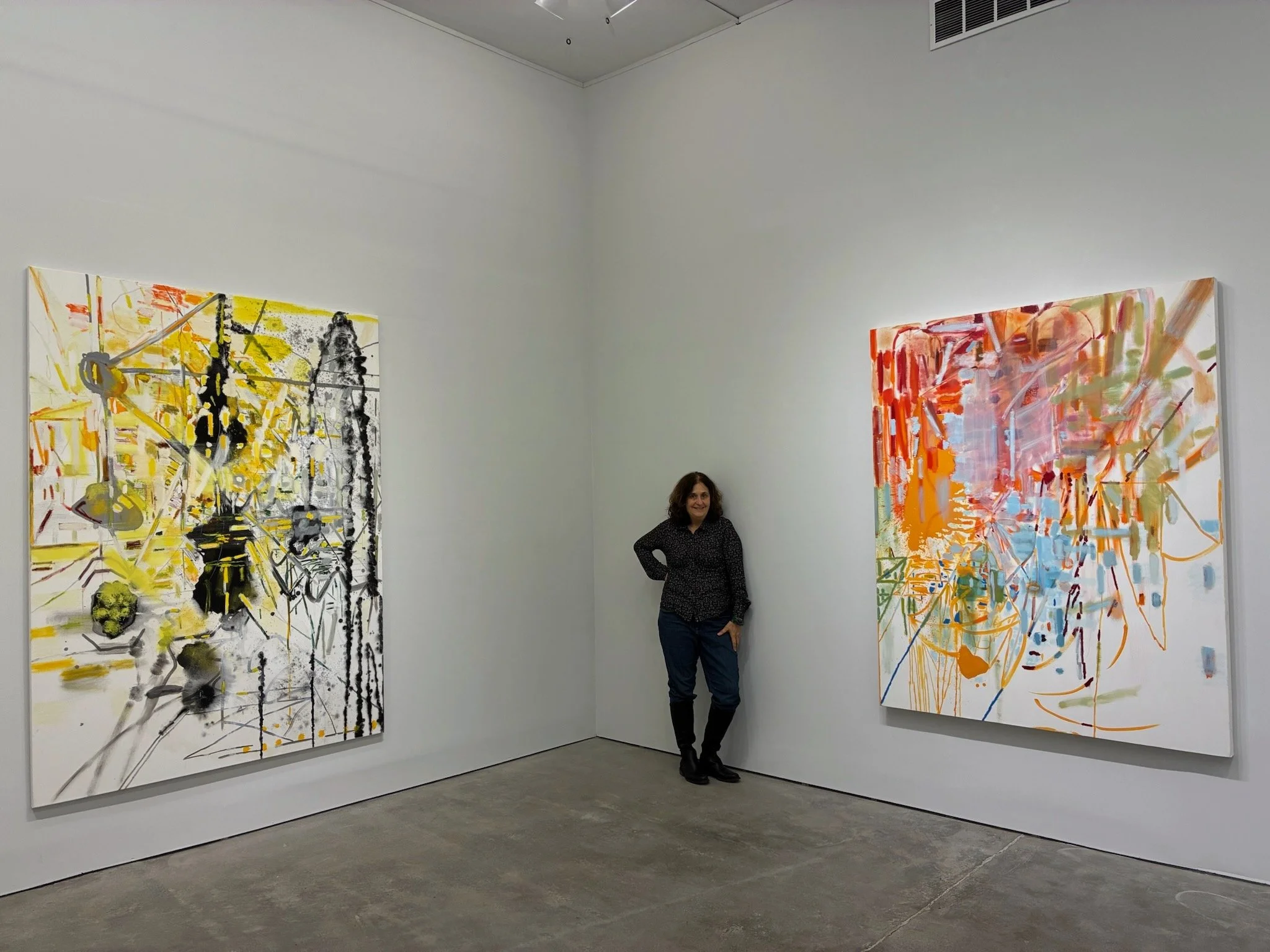
Kylie Heidenheimer at her solo exhibition, “Here, Elsewhere”, Private Public Gallery, November 29, 2025 - January 24, 2026. Photo by Emily Berger.
Kylie Heidenheimer came to painting through an early interest in art restoration. After high school, she attended Grinnell College in Iowa, where she studied chemistry, art history, and 2-D studio art. Following her freshman year, she spent the summer as an art restoration intern at the Museum für Völkerkunde in then West Berlin. While there, she began drawing and painting with gouache on paper on her own. By the end of that summer, she had decided to pursue art seriously. Not long after, her focus shifted to oil painting.
Her path toward abstraction grew out of a strong foundation in figurative work. After her sophomore year at Grinnell, she returned to St. Louis to attend art school at Washington University. The core program was rigorous and heavily figurative, with intensive anatomy drawing and figure sculpture classes, followed by a return to painting.
What drew you to abstract painting?
When I moved to New York and was painting on my own, things gradually became more abstract. I still, to this day, think quite figuratively. The abstraction comes in, I believe, from assembling various marks and open areas together that are broad in expanse. In that regard, what I do might also be viewed as a distorted, stretched, or attenuated figuration.
Let’s start with your recent solo show, Here, Elsewhere, at Private Public Gallery. Tell us about your body of work in this exhibition.
The works in the show were made between 2023 and 2025, but most pieces were started much earlier. I work out of two studios, one on the Lower East Side of NYC and the other Upstate. Each is about 300 square feet. I was fortunate that the person who makes my stretcher bars could handle orders and deliveries to both places. Because of the two studios, I was able to have breaks from one space while working in the other. This provided the opportunity for repeated “fresh looks” at the body of work in each studio, which informed the work in the show. I think the latter helped with seeing things in totality. The expansive open areas, marks, and lines within the works, at least in part, came from this process. A sense of shifting scrims that overlap, bulge, and retract within a receding ethereality developed. Some of the edges land within the canvases at times, and dart off of them at others. The show title, Here, Elsewhere, represents how the immediate and what is further away, ultimately interweave. Abstraction is certainly a force in allowing this to take place.
Let’s take a closer look at Chasm and Net (from ‘Pointing to’ Paintings II). What is the genesis of each painting? How do you see the relationship between them?
Actually, they could not have started out more differently. Chasm, 2024, grew from revisiting an earlier painting, Spectacle. The original piece was created when I was still working in acrylic, circa 2009. At that juncture, I was ceasing to pour paint in pieces and had missed the use of the hand. The use of the hand came back in the form of both loose marks and a line that felt drawn and incised within the surface. Additionally, Net, 2025, began on the floor. Similar to my earlier work, it began with pours. With regard to the two paintings’ relationship to one another, I think together, they speak to dissonance, as Bill Arning phrased it in his Two Coats of Paint review of the show.
Chris Freeman of Private Public hung the exhibition. He found, unlike my earlier work, that the pieces in this show were self-contained, within their own worlds. Accordingly, when hung side by side, they did not speak to one another in a conversational sense. He shaped the show’s installation in accordance with this dissonant dynamic. For example, when Chasm and Net were hung, they brought more together than when apart; the space between them created a kind of force field. Not a magnetic one, but rather one of compressed resistance. I saw the paintings in the show as furthering these dynamics within themselves.
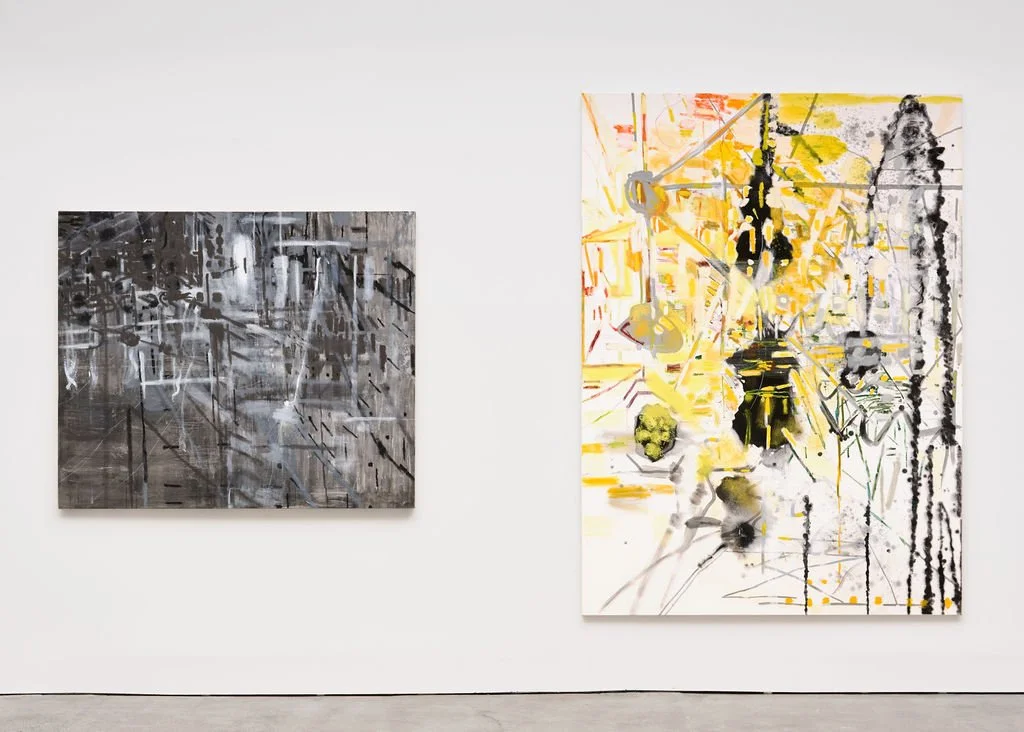
Installation view, Here, Elsewhere, Private Public Gallery. Photo by Luca Pearl Khosrova
You seem to work on long-term series of paintings, for instance, Reverse Paintings I from 2014 to 2017, then Reverse Paintings II from 2018 to 2020. Tell us a bit about this body of work – what does Reverse stand for? How do you see a “series” as complete, and can you describe how the shift occurred in 2018?
Reverse stands for a lot of the structure or armature that remains as the dominant visual in the final piece. This allows the viewer to look down and into the work, as well as provides an awareness of what remains outside. I do not see a shift in focus between bodies I and II. Splitting the work up is a way of marking their making through time. It makes each portfolio easier to view in total, as well as to curate. I see a series as complete (in this case, moving from Reverse Paintings II 2020–2018 to “Painting To” Paintings I 2025-2021) when a shift in thinking about them begins to assert itself. I have become more aware, starting around 2021, of how my traversing the canvas from one end to another has entailed a kind of ‘selflessness’ on behalf of any given piece’s elements. A mark, for example, seems less about asserting itself than it does about deflection. Namely, it ‘points to’ its surroundings, whether it is the space around it, another similar mark, or a contrasting shape.
Your earlier paintings were made with acrylic. I am looking at your Raised Grid Paintings (1998-2004). What drew you to acrylic, and how did this medium impact your approach to abstract painting? Let’s look closely at Night (2001) as an example.
I began painting in acrylic around 1995. I was without a studio and working at home in my apartment. Since I was messy and capable of spreading paint and fumes anywhere, working in water-based paint became necessary in the smaller confines. It was also more immediate. Acrylic proved effective even after getting a studio again in 1998. I could come in at night after my day job and layer things without worrying about everything not being dry or muddying up. Works such as Night, 2001, were a later evolution in the use of acrylic. The latter was mixed with medium and pushed through a screen. As I’ve mentioned elsewhere, broad, ecumenical approaches and interferences, such as those provided by the screens, lent themselves to my work leaning towards the abstract. I am not sure acrylic, per se, had anything to do with this shift. I think that my tendency to see and do things on a broader scale is not tied to any medium.
In Hunter College’s darkroom, in doing late-night graduate school photo murals, developing the murals was a collaborative process where two people were needed to roll large pieces of exposed photo paper up and down in a narrow chemical-filled trough. It was here that someone commented on how abstract my work was, and this was with a Diana camera!
What was driving me in 2001 and my body of work at the time was the beginning of the removal, but not the elimination of the hand. The screen served as an interference with that. I was after a dialogue between what was die-cut and manufactured, and what can grow from the force of the hand and body. “Sans hand” further accelerated around 2004-5 when screens and interfering objects no longer touched the surface of the support. In those instances, what became the ensuing “Pour Mask” series, the emphasis was upon achieving a pristine quality. I had just driven through the Adirondacks for the first time and was taken by how untouched the waters and surroundings were.
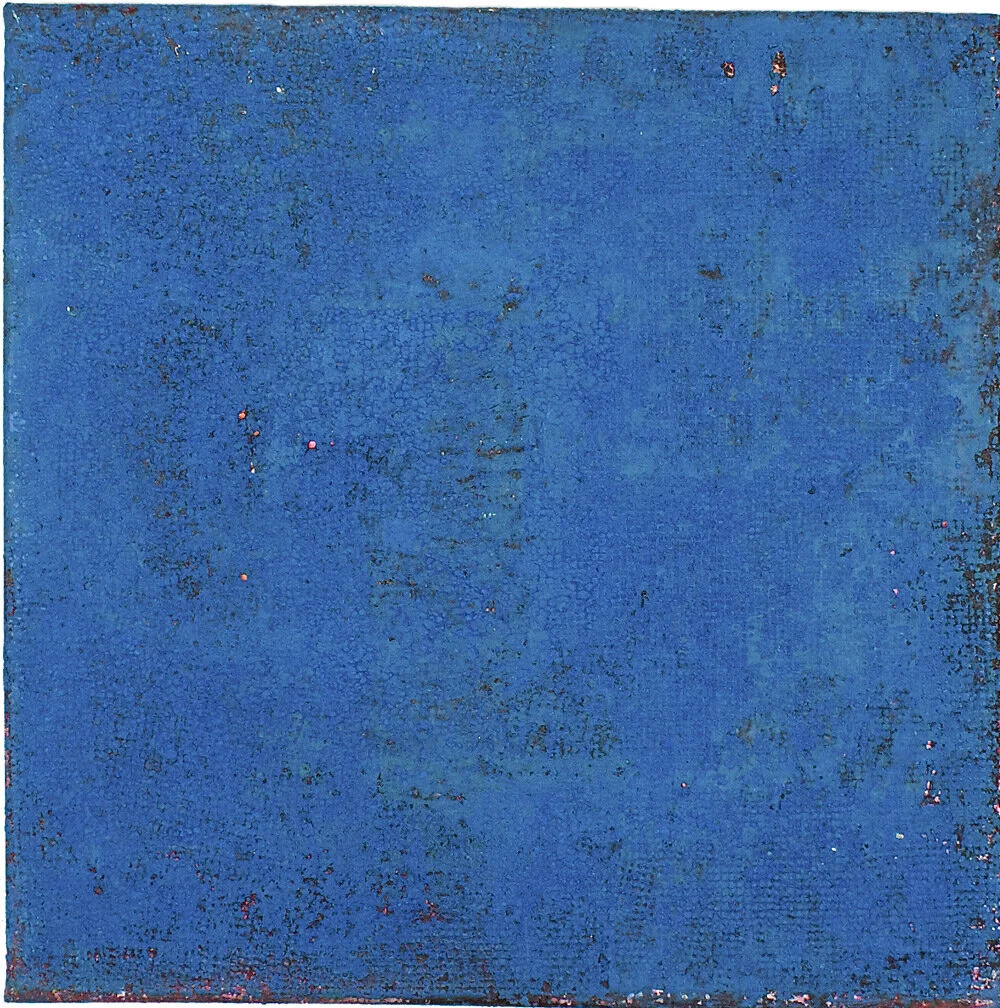
Kylie Heidenheimer, Night, 2001, acrylic on canvas, 24 x 24 inches
You transitioned to painting in oil. Your Mark/Tack Paintings (2007-2013) seem to mark this phase. Tell us about this transition period. What drew you to oil, and how has it impacted your paintings?
Transitioning away from the pristine and back to the mark in acrylic worked just fine initially. This changed around 2010, when colors in the work became brighter and more saturated. This emphasized acrylic’s plastic and non-breathing qualities for me. Neither were things that I was after. Returning to oil paints and their organic qualities eliminated a lot of this.
Let’s go back to your recent ‘Pointing to’ paintings. You divide this body of work into two, but they occur over the same period of time (‘Pointing to’ Paintings II from 2025-23 and ‘Pointing to’ Paintings 2025 – 2021). Let’s take a look at Inlet, 2025 (‘Pointing to’ Paintings II) and Embark, 2025 (‘Pointing to’ Paintings I).
“Pointing to’ Paintings II represents the work that was in the Private Public show. I find it interesting that you chose Inlet, 2025, from that body of work to discuss, as that piece essentialized the work in the exhibition for me the most. It did this, perhaps, by being smaller in scale than many, at 36 x 36 inches. For these reasons, it was the image for both the show’s card and the catalog cover. I also saw its inspiration as the most straightforwardly art-historical of all the show’s work, namely the influence of Edvard Munch’s landscapes. I had seen a show at The Clark with them in the summer of 2024. I could not believe how great they were and how little I knew about them.
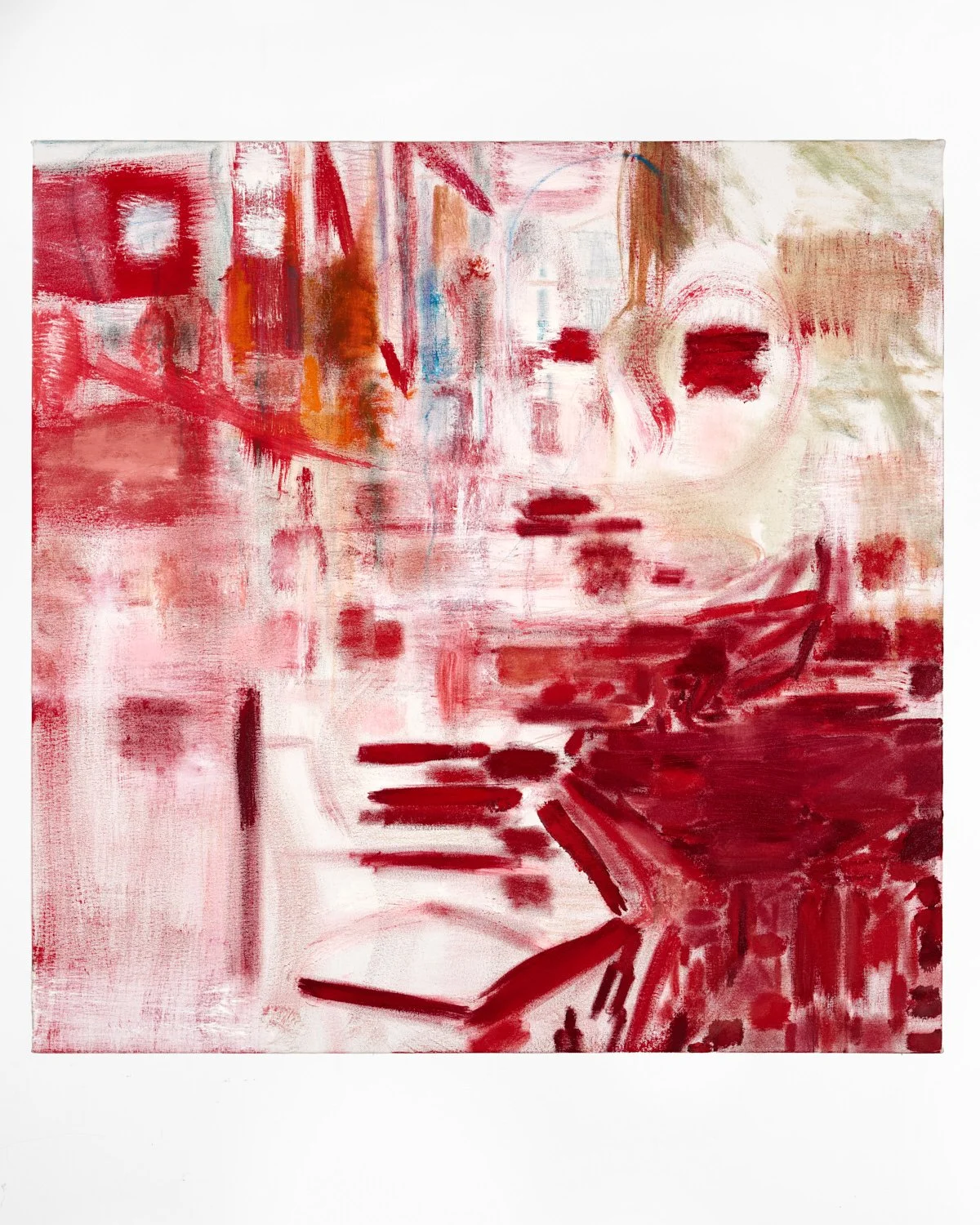
Kylie Heidenheimer, Inlet, 2025, oil on canvas, 36 x 36 inches, photo by Adam T. Deen
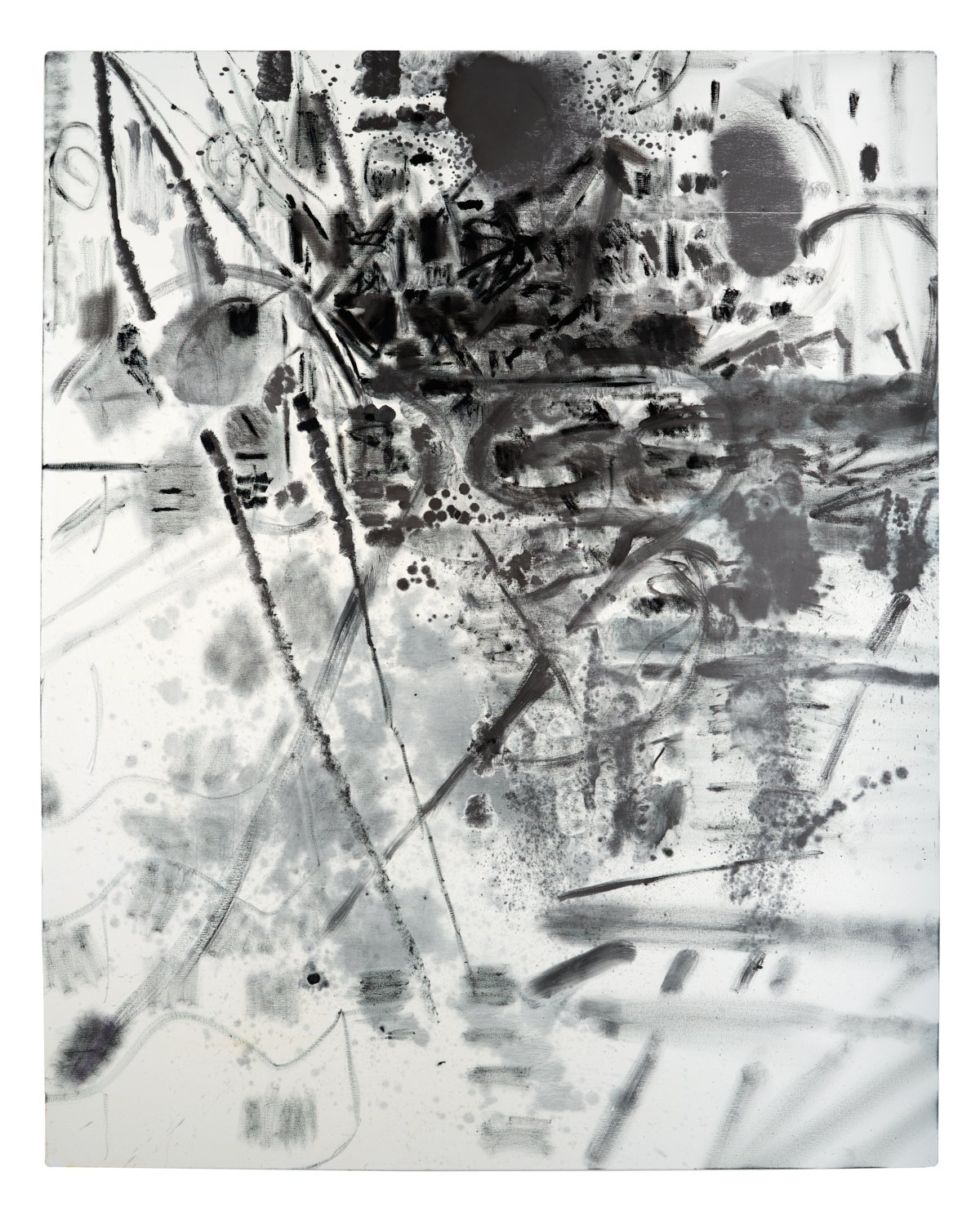
Kylie Heidenheimer, Embark, 2025, oil on canvas, 75 x 60 inches, photo by Adam T. Deen
This painting and another of the same size, Delve, 2025, were inspired by cave paintings. Longing is a powerful force in my work, and cave painting generally embodies it. There is also a sense of looking out and beyond in cave painting. In Embark, there are prominent formal sections on the right that run off the canvas. On the left, an animalistic figure gazes beyond.
You also make prints and work on paper. Can you tell us about your approach to working on paper versus canvas or wood? Has working on paper informed your painting, and how does it differ from painting for you?
At one point, paper did inform canvas for me. Its tight weave allowed me to make the soaks and marks I wanted in ways that held up and were not overtaken by the paper. I began to choose tighter canvas and linen weaves as a result. The question of paper vs. canvas also led me to the dilemma of drawing vs. painting. I increasingly – but not entirely – find the two to be indistinguishable. This might explain the untouched areas in the paintings. We readily accept such areas in drawing. For me, they can also take place in painting.
Regarding prints, while I’ve been making monoprints on and off since 2016, the incised-like marks in the paintings speak to a longing for intaglio. I had done quite a bit of intaglio work as both a graduate and an undergraduate student. It has resurfaced in combination with monoprints recently in the form of dry point. Lastly, I also work with Yupo, which differs greatly from canvas for me. It is as if paint were gliding across a kitchen counter.
How do you see your work in the context of art historical and current abstract painting?
My inkling that a painting is contemporary/ current – abstract or otherwise – is that it does not quite come from a place where painting was before. I know that is a very broad and expansive definition. It may relate to, and have kinship with, modernity or earlier periods, but its reason for being differs. In this respect, language within painting serves as a vessel(s). One’s love of earlier art may be within it, but memory and longing distort and evolve raison d’êtres between then and now. Historically speaking, Cezanne is a major force. I see him as much a builder as I do a painter. He is the father of an in-real-time way of working. With regard to current work, I see my work in the context of that of Janis Provisor, Brenda Goodman’s new and earlier work, Laura Newman, Jeffrey Bishop, and Per Kirkeby. These are just a few examples.
About the artist: Kylie Heidenheimer interweaves density and atmosphere across breadths and depths in her abstract paintings. She has a BFA from Washington University, St. Louis, and an MFA from CUNY Hunter College. Her work has been the subject of solo shows at Private Public Gallery, Hudson, NY; Galerie Gris, Hudson, NY; Thomas Jaeckel Gallery, NYC; Ohio Northern University, Ada, OH; The Italian Academy at Columbia University, NYC, and J.C. Flowers, NYC. She has participated in group exhibitions at Icebox4, Brooklyn; Zürcher Gallery, NYC; 56 Henry, NYC; Waterhouse & Dodd Gallery, NYC; O’Flaherty’s, NYC; Furnace Art on Paper Archive, Falls Village, CT; UT Knoxville, Knoxville, TN; and the Miller School of Architecture, Columbus, IN. Heidenheimer was a visiting artist at St. Mary’s College, Maryland, in 2025 and 2024, and a Yaddo guest in 2020 and 2016. She co-curated with Camilla Fallon the 2019 exhibition Incise, Echo and Repeat at Abrazo Gallery, NYC. She lives and works in NYC.
About the writer: Etty Yaniv is a Brooklyn-based artist, writer, curator, and founder of Art Spiel. She works in installation, painting, and mixed media, and has shown her art in exhibitions across the United States and abroad. Since 2018 she has published interviews and reviews through Art Spiel, often focusing on underrecognized voices and smaller venues. More about her art can be found at ettyyanivstudio.com and on Instagram @etty.yaniv
Artists Kylie Heidenheimer Categories In Dialogue, Interviews Tags abstract painting, abstraction, acrylic painting, art and material exploration, art and process, Bill Arning, canvas painting, contemporary art, contemporary painting, drypoint, exhibition review, feminist art, gesture in painting, intaglio printmaking, mark making, materiality in art, mixed media, monoprint, painting process, painting techniques, process-based art, studio practice, surface and texture, Two Coats of Paint, visual language, Yupo paper
© 2026 Artspiel